
On-Site vs. Off-Site Data Destruction: Which Method Best Protects Your Enterprise?
8 min read · 23 May 2026
TL;DR
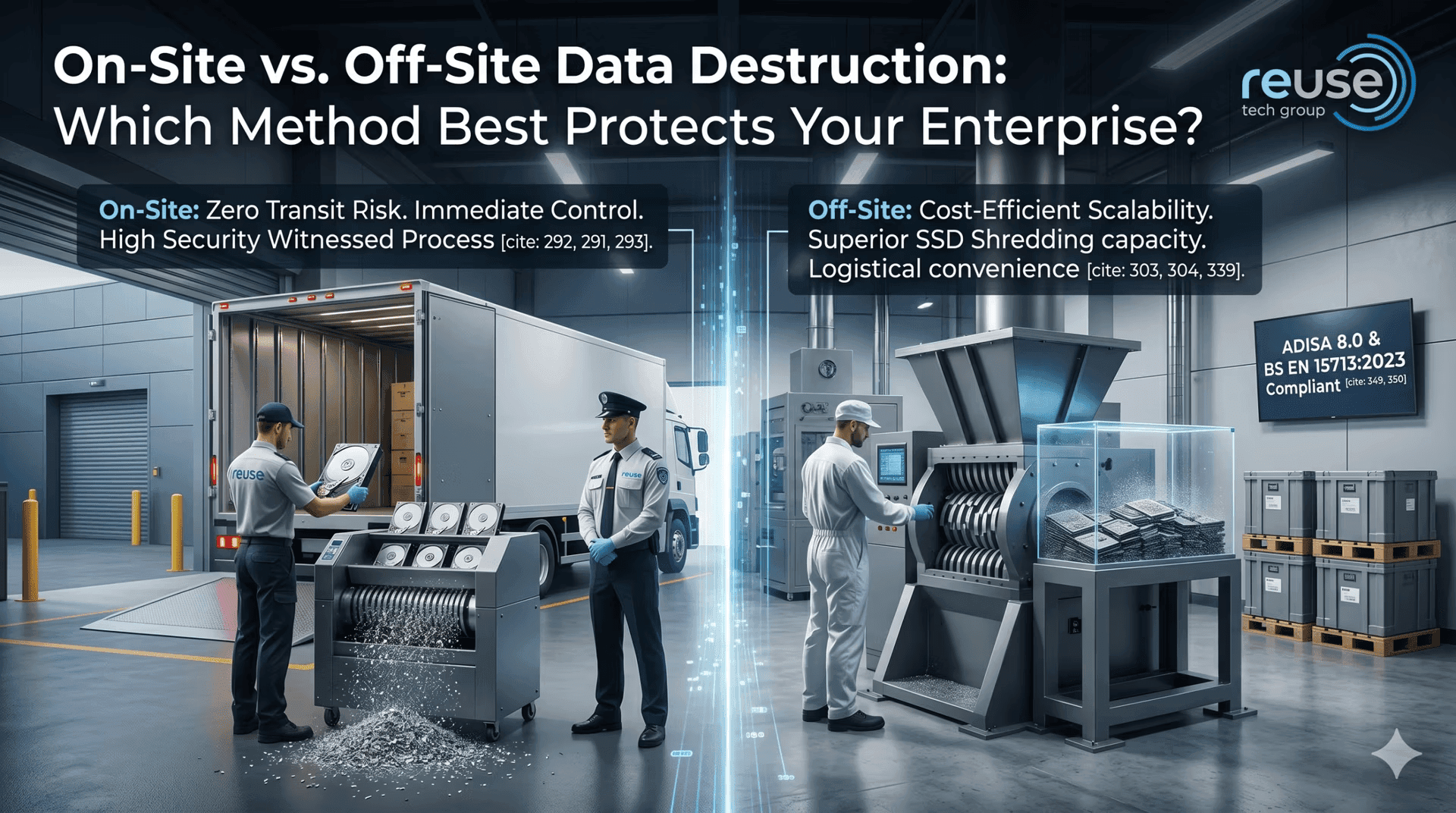
Choosing between on-site and off-site data destruction requires balancing risk against efficiency. On-site methods eliminate transit risk, delivering absolute security for regulated sectors. Conversely, off-site services offer superior convenience, cost efficiency, and the advanced industrial capacity required to shred high volumes of modern enterprise SSDs.
Securely managing end-of-life IT assets is no longer just a peripheral logistical task delegated to facilities management; it is a critical pillar of corporate risk management, brand protection, and regulatory compliance. As computing power shifts toward the edge and hardware refresh cycles accelerate to meet the demands of advanced processing, Chief Information Officers (CIOs), Chief Sustainability Officers (CSOs), and Compliance Directors are frequently confronted with a profound architectural decision: how and where to destroy highly sensitive corporate data permanently.
This initiates the ultimate on-site vs off-site data destruction debate. Evaluating these two distinct risk methodologies often creates psychological friction for buyers. On one hand, you have the absolute certainty of immediate physical destruction under the watchful eye of your own security team; on the other, you have the operational convenience and economic scalability of centralised facility processing. This comprehensive comparison guide will objectively evaluate the specific merits, technical limitations, and compliance implications of both approaches to determine which methodology best protects your enterprise.
The Anatomy of Enterprise Data Risk and Psychological Friction
Before choosing a methodology, it is vital to establish the taxonomy of risk that IT Asset Disposition (ITAD) programmes are engineered to mitigate. When a corporate device is decommissioned, the physical asset is removed from the protective perimeter of the enterprise network—stripped of its firewalls, active monitoring, and intrusion detection systems.
The primary vulnerability dominating the commercial evaluation of data destruction is transit risk. When data-bearing devices leave a secure corporate data centre to be transported to a third-party processing facility, they enter a window of elevated exposure. During this logistical phase, assets could theoretically be subjected to opportunistic theft, accidental misplacement, or targeted malicious interception.
The psychological friction experienced by compliance directors predominantly stems from this transfer of custody. Relying on a third-party logistics provider requires immense institutional trust. To successfully mitigate this, the chosen methodology must not only guarantee absolute physical destruction or data sanitisation, but it must also be backed by an ironclad, legally binding audit trail. Furthermore, heavily regulated sectors managing classified data often demand a witness process, enabling internal security personnel to visually confirm the total obliteration of hard drives.
On-Site Data Destruction: The Architecture of Absolute Control
On-site data destruction, frequently referred to as mobile shredding or mobile sanitisation, involves deploying certified security personnel and highly specialised destruction equipment directly to the client's premises. Whether this operation takes place in the loading bay of a corporate headquarters or the secured compound of a colocation data centre, the core premise remains identical: the data-bearing devices are destroyed before they ever cross the threshold of the organisation's property line.
The fundamental value proposition here is the provision of maximum absolute security. Because the data never leaves your property intact, this methodology intrinsically achieves zero transit risk. This approach caters directly to the psychological needs of information security professionals by facilitating an immediate witness process. Enterprise security personnel can physically observe the hard drives being fed into the mobile shredding unit, providing unparalleled, visceral assurance that no data leakage can occur. Furthermore, the instant issuance of an itemised Certificate of Destruction provides a real-time, legally binding audit trail before the vendor even departs the premises.
On-site destruction meets the stringent compliance requirements of regulated industries like healthcare, government intelligence, and financial services, which manage extremely sensitive data classifications that legally cannot be transported intact.
However, this fortress-like security introduces significant commercial and operational friction. Mobile shredding trucks require physical staging space and adequate power access, and they generate considerable industrial noise pollution during mechanical cycles. Furthermore, the high operational costs associated with mobilising specialised vehicles, deploying security-vetted personnel, and absorbing fuel surcharges result in a substantially higher cost-per-unit, making it economically inefficient for low-volume or highly frequent hardware collections.
Off-Site Data Destruction: The Economics of Scale and Efficiency
Off-site data destruction relies entirely on the integrity of a highly secure logistics chain. End-of-life IT assets are collected directly from the client's facility, scanned into encrypted inventory systems, transported in sealed, GPS-tracked vehicles, and delivered to a specialised, access-controlled ITAD processing hub.
Off-site data destruction is fundamentally engineered for client convenience and economic scalability. By centralising the destruction process, ITAD vendors benefit from massive economies of scale, vastly reducing the cost-per-unit for large corporate projects. This economic advantage makes off-site processing vastly more suited for high-volume, large-scale commodity hardware refreshes. When a multinational organisation is depreciating thousands of endpoints or mobile telephony fleets, routing these assets to centralised hubs is the most budget-conscious strategy.
From an operational standpoint, off-site destruction minimises internal friction. The collection process is rapid, quiet, and clean, deliberately moving the heavy industrial processes away from the professional corporate environment to ensure zero disruption to daily business operations.
To overcome the inherent psychological barrier of transit risk, enterprise-grade off-site data destruction relies on rigorous compliance frameworks. Premium vendors deploy stringently vetted employees (cleared to standards such as BS 7858 in the UK) and maintain unbroken vehicle telemetry. Additionally, comprehensive insurance mechanisms, such as Downstream Data Coverage designed for NAID AAA Certified vendors, explicitly indemnify the client against financial losses resulting from vendor error or theft during the transportation phase.
Strategic Comparison Matrix
To facilitate objective commercial evaluation, the following matrix details a direct hard drive shredding comparison across the core evaluation vectors of Security, Cost, Convenience, and Compliance.
| EVALUATION VECTOR | ON-SITE DATA DESTRUCTION | OFF-SITE DATA DESTRUCTION |
|---|---|---|
| Security | Offers maximum absolute security by achieving zero transit risk. Sensitive data never leaves the premises intact. | Delivers high security managed via strict chain-of-custody protocols and GPS tracking during transit. |
| Cost | Imposes a high cost premium, particularly for small batches, due to the mobilisation of mobile shredding units. | Superior cost-efficiency; massive economies of scale make it ideal for high-volume, large-scale hardware refreshes. |
| Convenience | Carries a high potential for workplace disruption, including industrial noise and physical staging space requirements. | Highly convenient, clean collection process that completely minimises operational disruption at your corporate headquarters. |
| Compliance | Enables a real-time witness process and provides instantly verifiable Certificates of Destruction. | Mathematically audited tracking (e.g., ADISA 8.0, BS EN 15713) with Certificates of Destruction issued post-processing. |
The SSD Technical Challenge and NIST 800-88 Standards
The ongoing commercial debate is fundamentally altered when examining the microscopic physics of hardware shredding. Treating all storage media identically is a critical failure point in modern risk management.
Traditional magnetic hard disk drives (HDDs) are relatively simple to destroy. Legacy physical destruction techniques, such as degaussing (which applies a massive reverse magnetising field to reduce the magnetic flux to virtual zero), work exceptionally well on HDDs. However, according to the NIST SP 800-88 "Guidelines for Media Sanitisation," degaussing is completely ineffective on modern Solid State Drives (SSDs) and flash-based memory. Because SSDs store data using electrical charges in microscopic NAND flash memory chips rather than magnetic fields, a degaussed SSD retains its sensitive data entirely intact and fully recoverable.
To ensure the absolute, unrecoverable destruction of an SSD, the media must be mechanically disintegrated into a particle size of 2 millimetres or less. This exposes a critical technical limitation of the on-site methodology: mobile shredding trucks are often constrained by vehicular weight and onboard power generation, sometimes struggling to consistently achieve this ultra-fine 2mm granularity without overheating.
Conversely, off-site processing unlocks superior technical capacity. Stationary ITAD hubs deploy robust, industrial-strength disintegrators anchored into concrete floors and powered by high-voltage electrical grids. These heavy-duty installations easily surpass the mechanical capabilities of any mobile unit, reliably reducing thousands of high-density SSDs to a fine, unreadable dust.
Value Recovery, Data Sanitisation, and the Circular Economy
While physical destruction provides visceral certainty, it destroys the residual monetary value of the hardware and interrupts the circular economy. As CSOs face mounting pressure to optimise Environmental, Social, and Governance (ESG) reporting, enterprise ITAD programmes are increasingly turning to advanced data sanitisation.
Data sanitisation (software wiping) applies rigorous logical methodologies to overwrite the data across all addressable memory locations without physically damaging the drive chassis. Certified wiping software—such as those approved to ADISA Assurance Level 5—can automate NIST 800-88 'Clear' or 'Purge' methods across thousands of devices simultaneously. This generates tamper-proof, immutable XML or PDF reports that cryptographically verify the erasure.
By successfully sanitising the media, fully functional laptops, servers, and mobile devices can be refurbished and remarketed. This revenue generation can significantly offset the total cost of the ITAD programme while producing verified ESG metrics, such as improved device reuse rates and calculated Scope 3 emissions reductions.
Conclusion: Engineering the Hybrid Strategy
The commercial debate between on-site and off-site data destruction is rarely solved by a monolithic approach. Rather, it requires aligning the methodology with the specific risk profile, data classification, and operational scale of your enterprise.
On-site data destruction remains the unequivocal gold standard for mitigating transit risk and achieving immediate chain-of-custody closure. It is highly recommended for regulated sectors like healthcare and finance managing classified data. However, for the vast majority of routine, high-volume commodity hardware refreshes, off-site data destruction presents the most pragmatic and commercially viable solution. It offers superior cost-efficiency, the immense mechanical torque required for SSD shredding, and the logistical scalability necessary to support complex global operations.
Ultimately, the most secure and commercially mature strategy is the deployment of a hybrid methodology. By leveraging on-site services for critical, high-risk assets and off-site ITAD facilities for high-volume endpoints, enterprises can optimise their procurement budgets, champion sustainability, and definitively protect their most valuable corporate data.
Ready to eliminate data liability without sacrificing your ESG goals? Request a confidential risk assessment and bespoke data destruction quote.