
The 'Hidden Data' Threat: Why Office Printers and IoT Devices are Security Risks
6 min read · 23 December 2025
TL;DR
Executive Summary Your office is likely more vulnerable than you think, and the threat isn't coming from a hacker in a hoodie—it's coming from the copy room. For Office Managers and Facilities Manager
Executive Summary
Your office is likely more vulnerable than you think, and the threat isn't coming from a hacker in a hoodie—it's coming from the copy room. For Office Managers and Facilities Managers, the modern workplace is filled with "hidden data" hazards. This guide addresses the critical security gaps found in everyday office equipment. We will explore why secure data sanitisation for reuse is the new gold standard, how to handle IoT device disposal without leaking network credentials, and how to navigate office equipment recycling risks to protect your organisation from liability.
The Printer Risk: More Than Just Paper
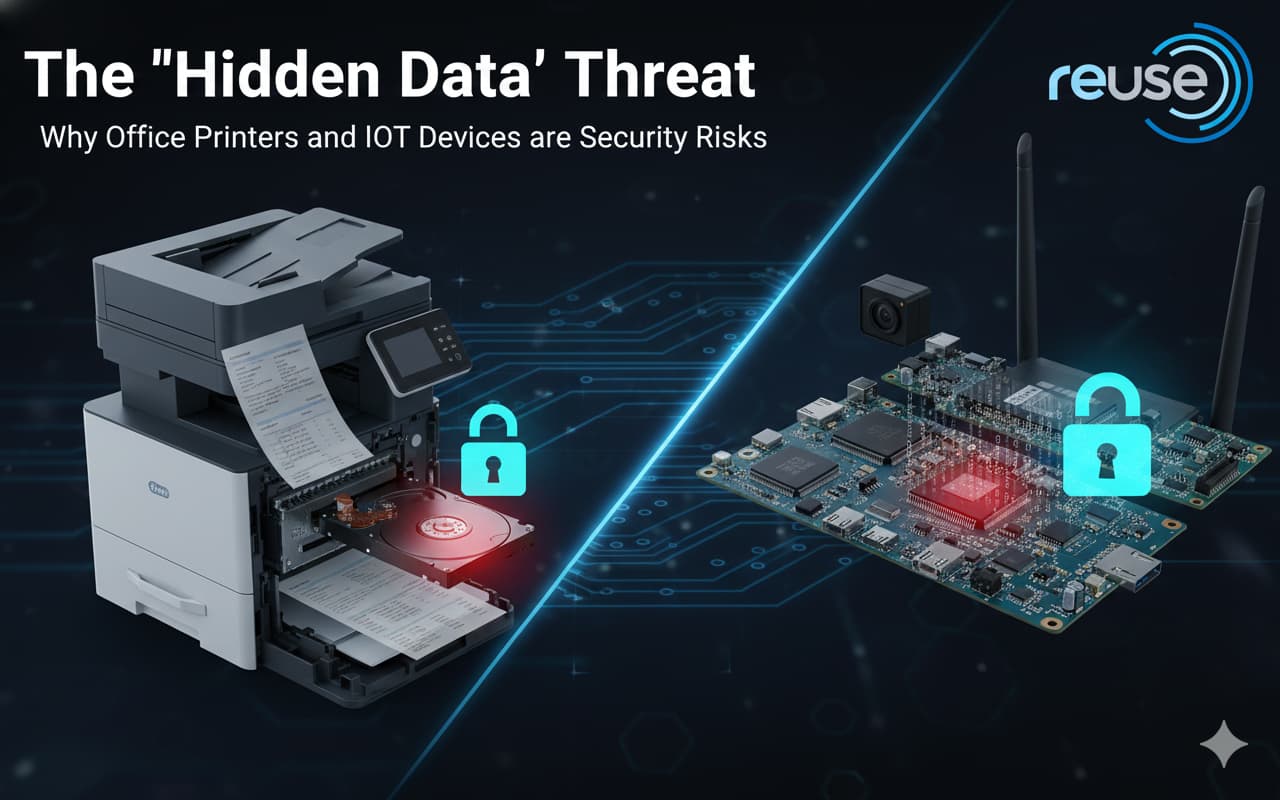
The most dangerous misconception in modern facilities management is that a photocopier is just a machine that duplicates paper. In reality, enterprise-grade Multifunction Printers (MFPs) are powerful computers with sophisticated internal hard drives.
The "Shadow Copy" Risk
- Persistent Storage: Since 2002, nearly every office copier has been built with a hard drive that stores an image of every document it processes.
- Sensitive Data: Whether you scan a W-2, copy a passport, or print a confidential merger agreement, that data is written to the driver.
- The Reality: If you return a leased copier without a secure wipe, you are essentially handing over a filing cabinet filled with your company's most sensitive secrets.
- The Evidence: Forensic investigations on used copiers have recovered police reports, medical records, and social security numbers from machines bought on the open market for as little as $300.
Secure Wiping & Reuse: The New Gold Standard
While physical destruction was once the primary recommendation, secure data sanitisation that allows for equipment reuse is the modern gold standard for balancing security with sustainability.
Priority: Secure Sanitisation (The Gold Standard)
- Software Overwrite: Use the printer’s built-in "Image Overwrite" or "Data Security Kit" features to scrub the drive before the machine is decommissioned11.
- Industry Standards: Follow NIST 800-88 "Purge" standards, which utilise cryptographic erasure or multi-pass overwriting to make data unrecoverable while keeping the hardware functional for its next life.
- Lease Flexibility: Negotiate your lease to allow you to perform secure wipes or remove the hard drive yourself before the machine leaves your facility.
Last Resort: Industrial Shredding
- Unrecoverable Drives: Physical destruction should be reserved for drives that are non-functional or cannot be securely wiped to industry standards.
- Certified Shredding: Once a drive is deemed end-of-life, it should be physically shredded or degaussed by a certified specialist to ensure zero data recovery.
The Hidden Dangers of IoT Device Disposal
While printers are the heavyweights of data storage, the Internet of Things (IoT) represents "death by a thousand cuts". Your office is likely filling up with smart thermostats, Wi-Fi-enabled light bulbs, and connected digital signage.
1. The "Spy" in the Fish Tank
- Bypassing IT: These devices are often installed by facilities teams for energy efficiency or convenience, bypassing IT security oversight.
- Credential Leakage: These devices store critical network information, including Wi-Fi SSIDs and passwords, often in plain text.
- Real-World Breach: In a famous incident, hackers breached a casino by compromising a smart thermostat inside a lobby fish tank, using it as a stepping stone to steal 10 gigabytes of data.
2. Secure IoT Disposal Protocols
- Avoid the "Factory Reset": A standard "Factory Reset" is often insufficient for IoT devices, as it may only clear user preferences while leaving cached network credentials intact.
- Industrial Shredding: For small, low-cost items like smart plugs or light bulbs where software wiping is not feasible, industrial shredding is the most effective method. This ensures the memory chips are completely pulverised.
- Strict Inventory: Maintain a strict inventory of all "smart" facility equipment to ensure it doesn't end up in a standard rubbish bin.
Corporate Data Sanitisation & Asset Disposal Policy
To formalise these protections, organisations should implement the following policy framework:- Reuse-First Mandate: The organisation shall prioritise software-based sanitisation (Overwriting/Purging) over physical destruction to support environmental sustainability without compromising security.
- Sanitisation Standards: All devices must be wiped according to NIST 800-88 "Purge" standards before leaving the facility.
- End-of-Life Destruction: If an asset cannot be sanitised for reuse, it must undergo industrial shredding.
- No "Free" Recyclers: The organisation shall avoid "free" recycling services that profit by reselling un-wiped equipment.
- Chain of Custody: A serialised "Certificate of Destruction" or "Certificate of Sanitisation" is required for every asset, documenting the specific serial numbers of the processed drives.
Vetting Your Disposal Vendor
You cannot outsource liability. If a recycler sells your old printer on eBay and data is recovered from it, the legal and reputational fallout lands on you, not the recycler.
Vendor Audit Questionnaire
When selecting a disposal or reuse partner, ask the following:- Do you hold ADISA, R2v3 or NAID AAA certifications? These standards require rigorous security audits, employee background checks, and secure chains of custody.
- What is your sanitisation protocol? Ensure they follow NIST 800-88 standards for data "Purge".
- Do you provide serialised documentation? You need a certificate that lists individual serial numbers, not just total scrap weight.
- How do you handle devices that fail sanitisation? They should have a clear process for immediate industrial shredding of failed drives.
Quick-Action Checklist for Office Managers
| Action Item | Why it Matters |
|---|---|
| Audit Inventory | You cannot secure what you don't know you have; identify all machines with hard drives. |
| Prioritise Wiping | Implement secure overwriting as the primary disposal method to allow for safe equipment reuse. |
| Secure Lease Returns | Never return a copier without signed confirmation that the HDD has been securely wiped or removed. |
| Shred End-of-Life Items | Adopt an industrial shredding policy for IoT devices like smart bulbs and thermostats that cannot be wiped. |
| Verify Certifications | Switch to an R2 or NAID certified recycler to mitigate office equipment recycling risks. |
Frequently Asked Questions
Is a factory reset enough for printer disposal?
Rarely. A standard reset usually only clears network settings. To ensure data is unrecoverable while keeping the hardware intact for reuse, you must perform a “Data Overwrite” or secure purge.
What are the risks of IoT device disposal?
The primary risk is the leakage of Wi-Fi credentials stored in flash memory. If an attacker recovers a discarded device, they can extract these credentials to breach your corporate network.
How do I ensure printer sanitisation is compliant?
Follow the NIST 800-88 “Purge” or “Destroy” standards. This involves either cryptographic erasure or physical shredding. Always obtain a serialised Certificate of Destruction or Sanitisation from your vendor.
Rarely. A standard reset usually only clears network settings. To ensure data is unrecoverable while keeping the hardware intact for reuse, you must perform a "Data Overwrite" or secure purge.
The primary risk is the leakage of Wi-Fi credentials stored in flash memory. If an attacker recovers a discarded device, they can extract these credentials to breach your corporate network.
Follow the NIST 800-88 "Purge" or "Destroy" standards. This involves either cryptographic erasure or physical shredding. Always obtain a serialised Certificate of Destruction or Sanitisation from your vendor.
Ready to turn a liability into a certified asset? Get your NIST 800-88 compliant disposal policy. Contact our certified experts today.