
Why Zero-Cost IT Recycling is a Regulatory Time Bomb in 2026
7 min read · 13 January 2026
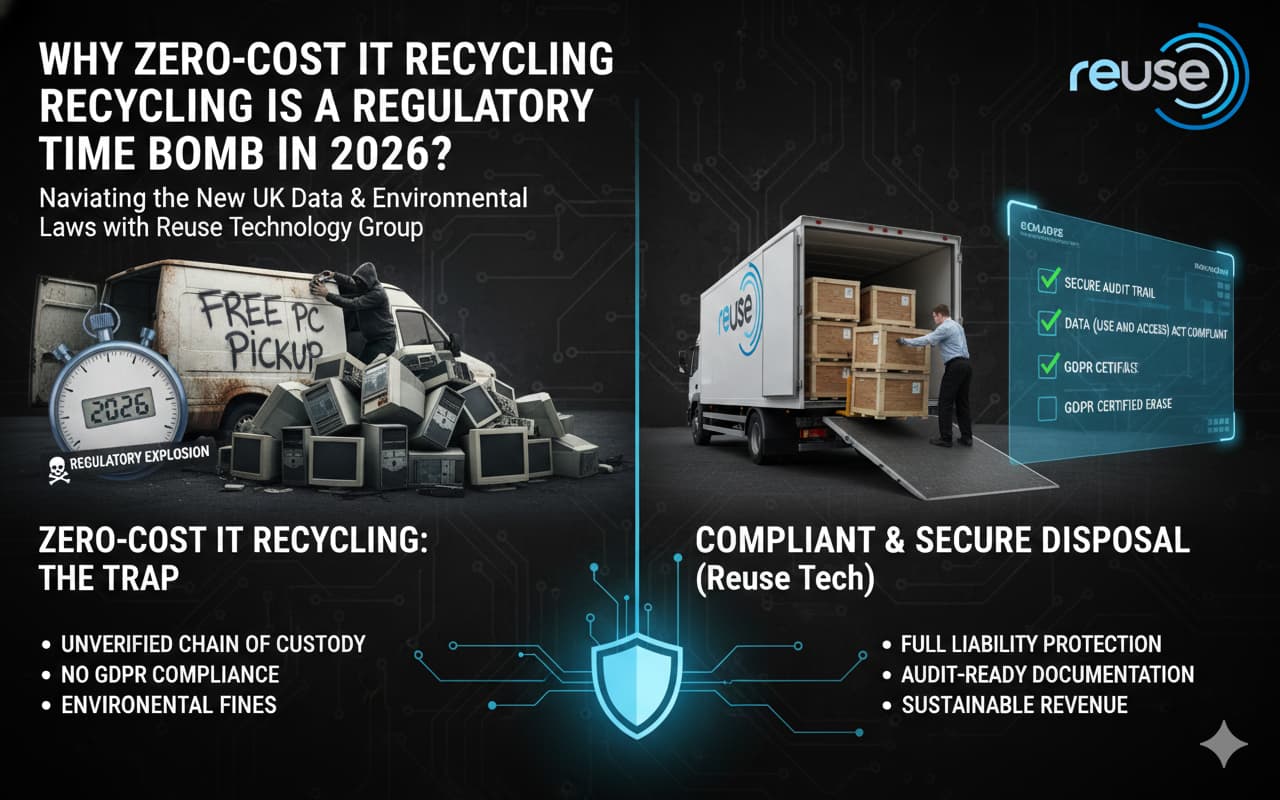
TL;DR
Executive Summary For UK CISOs in 2026, "free" IT recycling has become a critical regulatory risk. Following the 2025 Basel Convention amendments and intensified Environment Agency enforcement, zero-c
Executive Summary
For UK CISOs in 2026, "free" IT recycling has become a critical regulatory risk. Following the 2025 Basel Convention amendments and intensified Environment Agency enforcement, zero-cost disposal models now expose organisations to severe liabilities, including data theft and illegal export prosecution. This summary highlights why "free" vendors—often reliant on corner-cutting and "toxic colonialism"—are incompatible with modern compliance. The report advocates transitioning to a transparent Rebate Model, where service fees ensure rigorous NIST-compliant sanitisation and lawful downstream processing. To avoid GDPR fines and reputational damage, leadership must prioritise verified chain of custody over cost avoidance.
The "Free" Fallacy: You Are Not the Customer; You Are the Supplier
In the boardroom, the phrase "cost reduction" is usually music to the ears. However, when applied to IT Asset Disposition (ITAD), the word "free" should trigger an immediate alarm for every Chief Information Security Officer (CISO) in the UK.
As we move through 2026, the regulatory landscape governing electronic waste has shifted seismically. With the full implementation of the Basel Convention amendments and aggressive enforcement by the UK Environment Agency, the era of plausible deniability is over.
This article dissects the operational reality behind free computer recycling risks, exposing the mechanics of ITAD scams and the legal perils of illegal e-waste export.
To understand the risk, one must understand the economics. Legitimate ITAD is an industrial process involving secure logistics, GDPR-compliant data sanitisation (NIST 800-88), and hazardous material separation. These processes are labour and capital-intensive.
If a vendor offers to collect your retired assets for £0, they are operating on a mathematically impossible model without cutting corners. In the "free" model, your IT assets are not treated as sensitive data carriers; they are treated as scrap metal.
The vendor’s revenue relies entirely on the material value of the device. If commodity prices drop, or the device has low resale value, the "free" vendor must recover costs elsewhere.
Research indicates they do this via three primary mechanisms:
- Skipping Data Sanitisation: Simply formatting a drive costs pennies but leaves data recoverable. A full NIST purge costs money.
- Illegal Export: Shipping toxic waste to developing nations to avoid UK disposal fees.
- Cherry-Picking: stealing high-value items and fly-tipping the rest, breaking the chain of custody.
2026 Regulatory Update: The Basel Convention & UK Enforcement
The regulatory environment has tightened significantly since January 1, 2025. The "Green List" loopholes that unscrupulous vendors previously exploited have been closed.
The Basel Convention Amendments (Y49 & A1181)
As of early 2025, the Basel Convention introduced strict new codes for e-waste. Code Y49 now covers non-hazardous e-waste, while A1181 covers hazardous components. Crucially, the movement of all electrical waste now requires "Prior Informed Consent" (PIC) from the receiving country.
For the CISO, this means:
- The Non-Party Trap: The USA is not a party to the Basel Convention. Exporting e-waste to the US (or from the US to Basel-party countries) without specific bilateral agreements is now flagged as illegal traffic.
- The "Reuse" Fraud: "Free" recyclers often label broken equipment as "for reuse" to bypass these bans. However, if the equipment is not fully functional and tested, the UK Environment Agency classifies it as waste. If your asset tags are found in a container in Ghana, you (the producer) are liable for the illegal export.
Environment Agency Crackdowns
The UK Environment Agency is actively prosecuting producers for "Duty of Care" failures. Recent data highlights that ignoring downstream due diligence is no longer a defence. Fines for illegal waste exports have reached nearly £1 million for single offences, with directors facing personal liability.
The CISO’s Nightmare: Anatomy of an ITAD Scam
The risks of free services extend beyond environmental fines directly into the heart of data security:
1. The Morgan Stanley Warning
The definitive case study for free computer recycling risks remains the Morgan Stanley incident. By hiring a moving company rather than a certified ITAD specialist to decommission data centres, the bank lost control of the chain of custody. Drives were sold online containing unencrypted customer PII. The result? Over $163 million in fines and settlements.
2. The Chain of Custody Black Hole
In a free model, vendors often use third-party couriers who are unaware they are carrying sensitive data. Assets are often consolidated in unsecured warehouses. A common ITAD scam involves "ghosting"—where assets disappear from the inventory list before they are scanned, preventing the client from ever knowing they were lost.
3. Fake Certificates of Destruction
A PDF stating "All drives destroyed" is legally worthless. A compliant Certificate of Destruction (CoD) must link the specific serial number of the hard drive to the specific method of destruction (e.g., "Wiped to NIST 800-88 Purge" or "Shredded to 6mm"). "Free" vendors frequently issue generic certificates that fail audit scrutiny.
The 2026 Compliance Checklist for UK Leaders
To protect your organisation from illegal e-waste export liability and GDPR breaches, use this vetting framework for the upcoming year:
| Vetting Criteria | The "Free" Vendor (Red Flag) | The Compliant Partner (Green Light) |
|---|---|---|
| Business Model | 100% Scrap/Resale dependent. | Service Fee + Rebate (Transparent). |
| Certifications | Claims "compliance with ISO" (Generic). | Holds R2v3, e-Stewards, or NAID AAA, ADISA |
| Chain of Custody | Person and a van without any vetting or security clearance | Uses GPS-tracked, security-vetted fleets. |
| Insurance | General Liability only. | Specific Cyber Liability & Environmental Impairment Liability (EIL). |
| Audit Trail | Generic volume report (e.g., "500kg of IT"). | Serialised report for every data-bearing asset. |
The Sustainable Alternative: The Rebate Model
The solution to the dilemma of free computer recycling risks is the "Rebate Model." In this transparent approach, the client pays for the service (logistics and sanitisation) to ensure it is done legally, but receives a percentage of the revenue from the resale of functional assets.
Often, the value of the remarketed equipment exceeds the cost of processing, resulting in a net-positive financial return for the company—without the associated risks.
Executive Summary: Key Takeaways for 2026
- "Free" is a myth: You pay for free recycling with your risk profile. The cost of a data breach or environmental prosecution vastly outweighs the cost of proper disposal.
- Basel 2025 changed the game: New international codes (Y49/A1181) make the export of low-grade e-waste difficult and costly. Vendors charging £0 are statistically likely to be cutting corners on these new rules.
- Data Controller Liability: Under GDPR and the UK Data Protection Act, you remain liable for your data even after it leaves your premises. You cannot outsource liability to a budget vendor.
Action Item: Review your current ITAD contracts immediately. If you are not paying for the service, request a downstream audit trail today. If they cannot provide it within 24 hours, your data may already be at risk.
Frequently Asked Questions
Why is free computer recycling considered a risk in 2026?
Following the Basel Convention amendments in 2025, the cost of compliant recycling has risen. “Free” vendors often cannot afford these compliance costs and may resort to illegal e-waste export or skipping data wiping to maintain margins.
What is the difference between R2v3 and e-Stewards certification?
Both are high standards, but e-Stewards is generally stricter regarding the ban on exporting hazardous waste to developing nations, closing loopholes that allow ITAD scams. R2v3 focuses heavily on documenting the “reuse” hierarchy.
Can I be fined if my recycling partner dumps my IT equipment illegally?
Yes. Under the UK’s “Duty of Care” regulations and WEEE standards, the producer (you) can be held liable if your assets are found in illegal dumps, as you failed to ensure the waste was handled by an authorised facility.
What should a valid Certificate of Destruction look like?
It must include the serial number of the specific drive (not just the computer), the method of destruction used (e.g., degaussing, shredding), the date, and the signature of the technician. Generic certificates are a major red flag.
Following the Basel Convention amendments in 2025, the cost of compliant recycling has risen. "Free" vendors often cannot afford these compliance costs and may resort to illegal e-waste export or skipping data wiping to maintain margins.
Both are high standards, but e-Stewards is generally stricter regarding the ban on exporting hazardous waste to developing nations, closing loopholes that allow ITAD scams. R2v3 focuses heavily on documenting the "reuse" hierarchy.
Yes. Under the UK's "Duty of Care" regulations and WEEE standards, the producer (you) can be held liable if your assets are found in illegal dumps, as you failed to ensure the waste was handled by an authorised facility.
It must include the serial number of the specific drive (not just the computer), the method of destruction used (e.g., degaussing, shredding), the date, and the signature of the technician. Generic certificates are a major red flag.
Stop the ITAD Regulatory Time Bomb. Demand an audit-proof Chain of Custody and NIST-compliant sanitisation. Secure your compliance—Contact Us today.