
IT Reuse vs. Recycling: Environmental Impact and the Hidden Carbon Cost
7 min read · 22 January 2026
TL;DR
TL;DR: The "Reuse-First" Imperative Recycling IT assets should be your last resort. With roughly 80% of a device's carbon footprint tied to manufacturing (embodied carbon), recycling destroys this ene
TL;DR: The "Reuse-First" Imperative
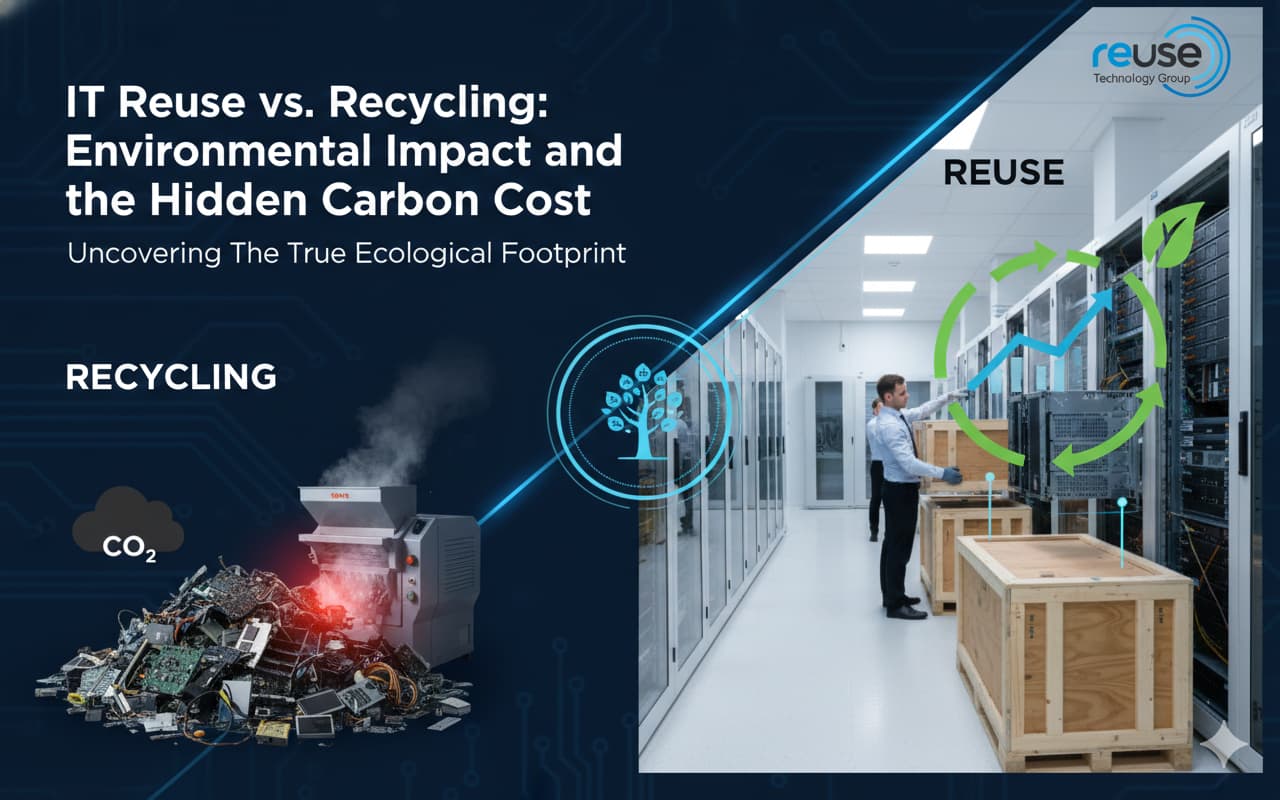
Recycling IT assets should be your last resort. With roughly 80% of a device's carbon footprint tied to manufacturing (embodied carbon), recycling destroys this energy investment while recovering less than 1% of critical minerals. Conversely, a "Reuse-First" strategy preserves embodied carbon, drastically reducing Scope 3 emissions. It also unlocks significant financial returns—often yielding value up to 15,000% higher than scrap rates. By prioritising reuse and utilising secure data sanitisation, organisations can turn IT disposition from a cost centre into a sustainable revenue engine.
"Recycling" has long been the default safety net for retired assets. It feels responsible, it checks a compliance box, and it clears out the storage room. But for modern enterprises, relying solely on recycling is a strategic error.
When we analyse the environmental impact of IT reuse versus recycling, the data is clear: recycling should be your last resort, not your first defence.
For IT leaders and procurement teams, the shift from a linear disposal model to a circular economy IT strategy isn't just about saving the planet—it is about recovering substantial economic value and practically eliminating Scope 3 emissions. Here is why the smartest move in IT asset disposition (ITAD) is to extend the life of your hardware.
Embodied Carbon Explained: The Iceberg Beneath the Device
To understand why reuse trumps recycling, we must first address the concept of embodied carbon.
In the past, we focused heavily on "operational carbon"—the electricity a device uses while plugged in. However, as devices have become smaller and more powerful, their environmental footprint has increased.
Embodied carbon explained: This is the cumulative greenhouse gas (GHG) emissions released during the extraction, refining, manufacturing, and transportation of a device before it is ever turned on.
For a standard enterprise laptop, 75% to 85% of its total lifecycle carbon emissions occur during manufacturing.
- Manufacturing (Embodied): ~300 kg CO₂e
- Three Years of Use (Operational): ~60 kg CO₂e
- End-of-Life (Recycling): ~5 kg CO₂e.
When you recycle a functional three-year-old laptop, you are effectively "throwing away" the 300 kg of carbon invested in its creation. No amount of operational efficiency in a new device can mathematically offset that loss. By contrast, keeping that device in circulation for a second life amortises that initial carbon debt over a longer period, drastically reducing its annualised impact.
The Physics of Waste: Why Recycling Destroys Value
There is a misconception that recycling is a perfect loop—that we can melt down a laptop and make a new one. Thermodynamics tells a different story.
Recycling is fundamentally a value-destroying process. It takes a highly organised, functional machine (low entropy) and shreds it into raw materials (high entropy). While this recovers basic commodities like steel and aluminium, it fails to recover the complex energy and labour invested in the device.
The Critical Minerals Problem
Modern electronics rely on Rare Earth Elements (REEs), such as neodymium (used in magnets) and Indium (used in displays). Due to their low concentration and chemical properties, these elements are nearly impossible to recover from shredded e-waste.
- Recycling Reality: The global recycling rate for Rare Earth Elements is less than 1%.
- The Reuse Solution: Reuse preserves these minerals in their functional state. A used hard drive magnet is still a magnet; a shredded hard drive is just scrap metal.
Circular Economy IT: The "Return to Gain" (RTG) Multiplier
For the B2B sector, the argument for reuse is as much financial as it is environmental. A circular economy IT model transforms the IT department from a cost centre into a value recovery engine.
When you designate assets for recycling, you are selling them for their commodity scrap value—the weight of the metal. When you designate them for reuse, you are selling them for their functional residual value. The difference in margin is staggering.
The Financial Gap Between Recycling and Reuse (Per Unit Estimates)
| Asset Type (3-Year-Old) | Scrap/Recycle Net Value | Reuse/Resale Net Value | Value Increase |
|---|---|---|---|
| Enterprise Laptop | $1.50 (Scrap Weight) | $150.00 - $300.00 | >10,000% |
| Smartphone | $0.50 | $50.00 - $200.00 | >10,000% |
| Rack Server | $10.00 (Steel Weight) | $200.00 - $1,500.00 | >2,000% |
By prioritising reuse, companies unlock "Return to Gain" (RTG) margins that can fund new technology initiatives, offsetting the cost of future refreshes.
Reuse and ESG: Crushing Scope 3 Emissions
With regulations like the EU's CSRD and California's climate disclosure laws coming online, companies are under immense pressure to report Scope 3 emissions (indirect emissions in the value chain).
For most service-based and tech companies, Category 1: Purchased Goods and Services is the largest source of emissions. Every new laptop you buy adds ~300+ kg of CO₂e to your ledger.
Adopting a reuse-centric procurement policy allows you to:
- Avoid Emissions: Extending refresh cycles from 3 to 4 years reduces your annualised procurement emissions by 25%.
- Displacement: Selling used assets into the secondary market displaces the manufacturing of new budget devices, preventing global emissions.8
- Reportable Wins: You can report verifiable metrics, such as "Extended the life of 1,000 assets, avoiding 300 metric tons of embodied carbon."
Implementing a "Reuse-First" Strategy
Moving up the waste hierarchy requires actionable changes in policy and vendor management.
- Update Procurement Policy: Explicitly state that "Reuse and Refurbishment" must be prioritised over "Recycling" for all functional assets.
- Rethink Data Security: Fear of data breaches often drives physical destruction (shredding). However, NIST 800-88 compliant software sanitisation (wiping) is just as secure and allows the asset to be reused. Demand digital Certificates of Data Destruction for every drive.
- Challenge Your ITAD Vendor: Do not accept "we recycle everything" as a good answer. Ask for a quarterly report detailing the % of assets resold vs. recycled. If your vendor isn't remarketing your gear, you are leaving money on the table.
Conclusion
The hierarchy is clear: Reduce, Reuse, Recycle. In the IT sector, we have spent too long focusing on the bottom of that pyramid. By understanding the true IT reuse vs recycling environmental impact, businesses can see that recycling is an industrial compromise, while reuse is a strategic advantage. It preserves the planet's resources, reduces corporate carbon footprints, and returns real value to the bottom line.
Frequently Asked Questions
What is the primary difference between IT reuse vs recycling environmental impact?
Reuse extends the lifespan of a device, preserving the massive amount of energy (embodied carbon) used to manufacture it. Recycling destroys the device to recover raw materials, which saves significantly less energy and often results in the loss of critical minerals in the process.
How much carbon does reusing a laptop save?
Reusing a single laptop can avoid approximately 300 kg of CO₂e emissions associated with manufacturing a new replacement. This is equivalent to taking a standard passenger car off the road for several weeks.
Is data security compromised by reuse?
No. Modern data sanitisation software (adhering to NIST 800-88 standards) permanently destroys data without physically damaging the hardware, making reuse safe for enterprise assets.
Stop leaving money and massive carbon savings on the table.
You've seen the data: a "Reuse-First" strategy transforms IT asset disposition from a cost center into a sustainable revenue engine, preserving embodied carbon and generating value up to 15,000% higher than scrap rates.
Ready to shift from recycling compromise to strategic advantage?