
Scope 3 Emissions and IT Hardware: The Hidden Carbon in Your Supply Chain
8 min read · 3 March 2026
TL;DR
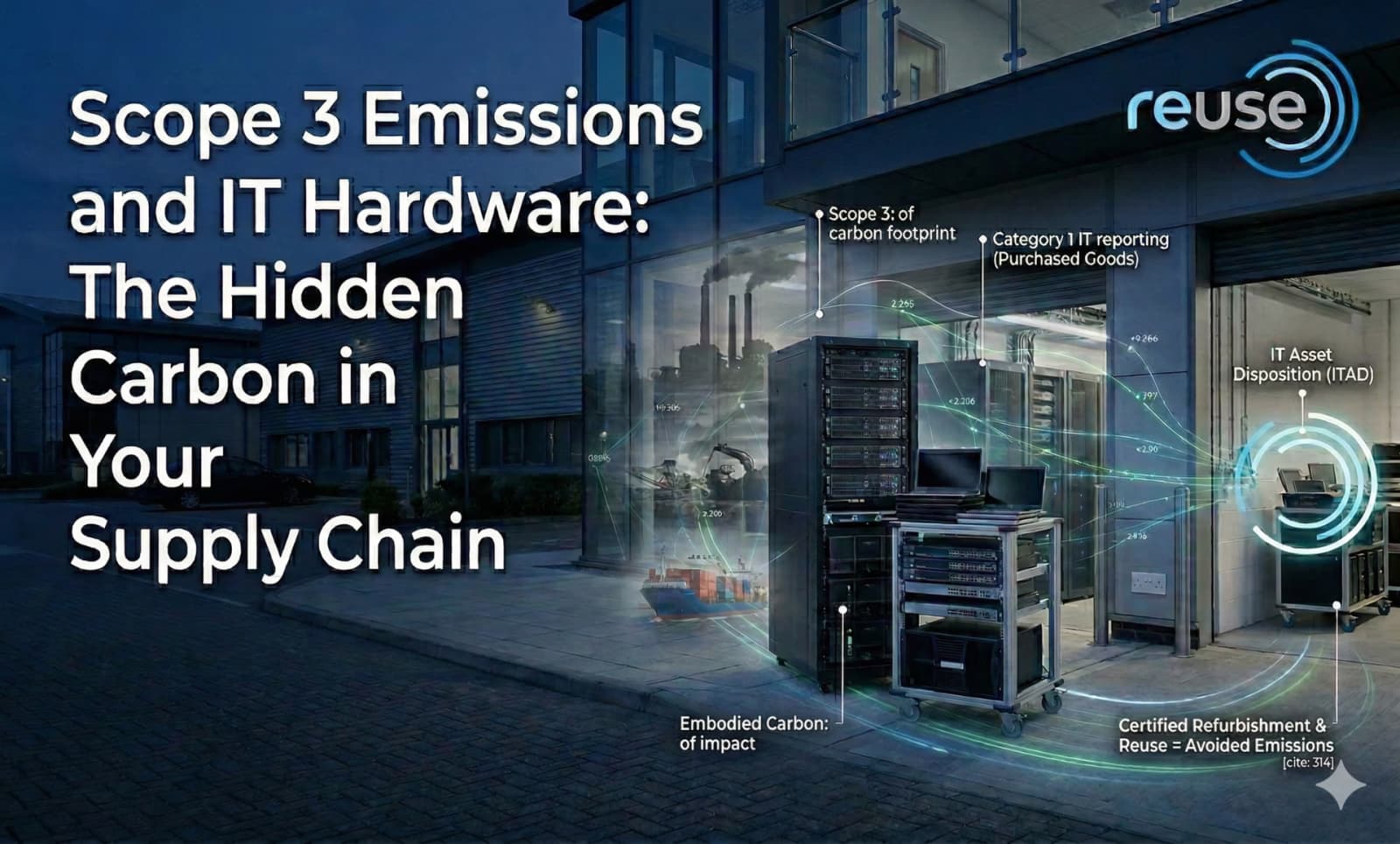
Scope 3 emissions, specifically Categories 1 and 12, drive 60-80% of service-sector carbon footprints. Embodied carbon represents up to 85% of hardware's lifecycle impact. Strategic ITAD programmes provide the "avoided emissions" data needed for GHG Protocol and CSRD compliance by extending device lifespans through certified refurbishment and reuse.
TL;DR
Scope 3 emissions, specifically Categories 1 and 12, drive 60-80% of service-sector carbon footprints. Embodied carbon represents up to 85% of hardware's lifecycle impact. Strategic ITAD programmes provide the "avoided emissions" data needed for GHG Protocol and CSRD compliance by extending device lifespans through certified refurbishment and reuse.
For the modern ESG Lead, the "climate math" is shifting. While your organisation has likely made significant strides in reducing Scope 1 (direct) and Scope 2 (energy-related) emissions, a much larger, more complex challenge is looming. For many service-based and high-tech organisations, Scope 3 emissions, IT hardware and other indirect value chain activities represent between 60% and 80% of their total carbon footprint.
The "hidden carbon" in your IT equipment is no longer just an environmental concern—it is a material liability. With CSRD compliance now a reality for thousands of firms and California’s SB 253 requiring full value chain transparency, IT hardware is emerging as a critical hotspot for carbon reporting.
This article provides an expert deep dive into how you can identify, report, and reduce emissions in the two most critical areas of your hardware lifecycle: Category 1 (Purchased Goods) and Category 12 (End-of-Life).
The Source of Truth: GHG Protocol Corporate Value Chain Standard
To build an audit-ready ESG report, you must rely on the Corporate Value Chain Standard. Released by the GHG Protocol, this is the only internationally accepted methodology for accounting for Scope 3 impacts.
For an ESG Lead, this standard provides the framework to map your supply chain across 15 distinct categories. When it comes to IT hardware, you are not just looking at the electricity your servers consume; you are assessing the carbon cost of mining raw materials, the energy used in semiconductor fabrication in Asia, and the final disposal of e-waste.
Category 1: Deciphering "Embodied Carbon" in IT Procurement
GHG Protocol Category 1 IT reporting covers "Purchased Goods and Services." This includes all "cradle-to-gate" emissions—every activity that occurs to a device before it reaches your office or data centre.
The Technical Reality of Embodied Carbon
In the IT world, the carbon footprint of a device is the sum of its embodied carbon CE and its usage carbon CU:
C = CE + CU
As global electricity grids undergo decarbonisation, the usage of carbon CU is dropping. However, the embodied carbon CE —the emissions from raw material extraction, manufacturing, and transport—remains a "sunk cost" that cannot be reduced once the item is produced.
For user devices like laptops and smartphones, embodied carbon typically accounts for 80% to 85% of total lifecycle emissions. This means that by the time you unbox a new laptop, the vast majority of its climate impact has already occurred.
Why IT Procurement is a Scope 3 Hotspot
According to a 2023 Accenture report, the high-tech industry’s Scope 3 emissions are 24 times larger than its Scope 1 emissions. A significant driver is the complexity of Tier 2 and Tier 3 suppliers—the companies that make the chips and components. These suppliers are often based in regions like China or the Middle East, where manufacturing processes can be up to six times more carbon-intensive than those in Europe due to the local energy mix.
Typical Embodied Carbon by Hardware Category
| HARDWARE CATEGORY | TYPICAL EMBODIED CARBON (CE) | PRIMARY IMPACT SOURCE |
|---|---|---|
| Laptops | ~80% | Integrated circuit (IC) fabrication & LCDs |
| Smartphones | ~85% | Miniaturisation & rare earth extraction |
| Enterprise Servers | ~20-40% | High-performance CPUs & large RAM arrays |
| Networking Gear | 100-250 tCO2e / MW | Fibre-optic components & large routers |
Navigating the Regulatory Landscape: CSRD and SEC Disclosure
The transition from voluntary disclosure to mandatory, audit-ready reporting has arrived, though the requirements vary by geography.
- CSRD Compliance: Under the European Sustainability Reporting Standard (ESRS E1), large companies must report their full Scope 3 emissions using the principle of "double materiality". This requires disclosing both how climate change affects your business (financial materiality) and how your IT supply chain affects the environment (impact materiality).
- SEC Climate Disclosure: In the United States, the SEC issued a final rule in 2024, but it faced immediate legal challenges. As of early 2026, the rule remains in a state of litigation abeyance, with the SEC declining to state whether it will enforce the rules until the court proceedings reach a conclusion.
- SBTi Requirements: Regardless of legal delays, the Science Based Targets initiative (SBTi) requires companies to set Scope 3 targets if those emissions represent more than 40% of their total footprint—a threshold met by nearly all technology and service firms.
Category 12: The Impact of Hardware End-of-Life Emissions
While Category 1 deals with the "birth" of your hardware, Hardware End-of-Life emissions fall under Category 12 (End-of-Life Treatment of Sold Products) or Category 5 (Waste Generated in Operations).
Improper e-waste management is a significant "leak" in ESG reporting. When assets leave your facility without a clear chain of custody, you lose the ability to verify if they were landfilled, incinerated, or recycled. Landfilling retired assets not only creates fugitive methane emissions but also "wastes" the embodied carbon already invested in those materials.
The Solution: ITAD as a Strategic Data Mechanism
This is where IT Asset Disposition (ITAD) becomes more than just a security or logistics function. A mature ITAD Scope 3 reporting programme transforms a waste problem into a high-fidelity data source for your ESG report.
From Waste Management to Carbon Avoidance
The most powerful tool in the ESG Lead’s arsenal is "carbon avoidance"—sometimes referred to as Scope 4. By refurbishing and reusing hardware rather than recycling it, you extend the device's lifespan. This avoids the need for a new device to be manufactured, effectively "displacing" the embodied carbon cost of a replacement.
The formula for carbon avoidance in hardware follows a comparative Life Cycle Assessment (LCA) approach:
Avoided Emissions = EmissionsNew Product − EmissionsRefurbished Product
By keeping a laptop in service for 6 years instead of 4, you can reduce the device's annual carbon impact by approximately 29%.
What to Demand from Your ITAD Partner
To ensure your data stands up to an audit, your ITAD partner must provide:
- Serialised Asset Tracking: A unique record for every device to ensure a transparent chain of custody.
- Verified Certifications: Look for vendors with R2v3 or e-Stewards certifications to guarantee environmentally responsible e-waste management.
- Disposition Breakdown: Clear data on which items were reused (high carbon benefit) versus recycled (lower carbon benefit).
- Data Destruction Certificates: Objective evidence that security was maintained alongside sustainability goals.
Summary: Building a Circular Economy for IT Assets
Managing the hidden carbon in your IT supply chain requires moving from a linear "buy-use-dispose" model to a circular economy for IT assets. By extending hardware lifecycles and utilising certified ITAD reporting, you can turn a difficult-to-measure Scope 3 liability into a clear, data-backed success story.
Tips for the ESG Lead: Strategic Recommendations
- Standardise PCF Data: Move away from "spend-based" estimates. Work with procurement to demand Product Carbon Footprint (PCF) data from hardware vendors.
- Audit Your ITAD Chain: Ensure your ITAD partner’s reports map directly to GHG Protocol categories 1, 5, and 12.
- Implement "Repair First" Policies: Extending your device refresh cycle from 3 years to 6 years can realise immediate Scope 3 reductions.
- Incorporate Circularity into RFPs: Add weight to suppliers that offer take-back programmes and use recycled materials.
Frequently Asked Questions
Does the SEC stay mean I do not need to report Scope 3?
While the federal SEC rule is currently in a legal stay in the US, regional regulations like California’s SB 253 and international standards like the CSRD still mandate Scope 3 reporting for large firms doing business in those jurisdictions.
What is the difference between a carbon offset and carbon avoidance?
A carbon offset is a credit purchased to compensate for emissions that have already happened. Carbon avoidance prevents emissions from occurring in the first place, such as choosing refurbished hardware instead of new.
How does Circular IT specifically help my ESG (Scope 3) reporting?
Laptops are dominated by embodied carbon (manufacturing). Servers, due to their massive power draw and 24/7 operation, have a higher proportion of usage carbon, though their embodied carbon remains a major “upfront” liability.
What certifications should I look for in an ITAD partner?
The gold standards are R2v3 and e-Stewards. These ensure that your hardware disposal meets rigorous environmental and data security requirements.
Laptops are dominated by embodied carbon (manufacturing). Servers, due to their massive power draw and 24/7 operation, have a higher proportion of usage carbon, though their embodied carbon remains a major "upfront" liability.
The gold standards are R2v3 and e-Stewards. These ensure that your hardware disposal meets rigorous environmental and data security requirements.
Turn Your IT Hardware Liability into a Data-Backed ESG Success Story.
Connect with our certified ITAD experts to achieve audit-ready Scope 3 reporting.