
How to Accurately Calculate the Carbon Footprint of Your Enterprise IT Hardware
10 min read · 22 April 2026
TL;DR
To accurately calculate your enterprise IT hardware carbon footprint, you must measure both operational electricity (Scope 2) and hidden supply chain manufacturing emissions (Scope 3). Avoid inaccurate spend-based estimates by leveraging product lifecycle assessments (LCAs) instead. Once measured, significantly reduce your impact by extending device lifespans, prioritising remanufactured hardware, and ensuring compliant e-waste disposal to meet UK SECR regulations and net-zero targets.
TL;DR
To accurately calculate your enterprise IT hardware carbon footprint, you must measure both operational electricity (Scope 2) and hidden supply chain manufacturing emissions (Scope 3). Avoid inaccurate spend-based estimates by leveraging product lifecycle assessments (LCAs) instead. Once measured, significantly reduce your impact by extending device lifespans, prioritising remanufactured hardware, and ensuring compliant e-waste disposal to meet UK SECR regulations and net-zero targets.
The modern paradox of corporate digital transformation is that as businesses modernise and "go paperless," their hidden environmental cost in the form of physical information and communication technology (ICT) is skyrocketing. While it is easy to assume that digital infrastructure is inherently green, the global supply chains supporting our devices consume vast amounts of natural resources and energy. For businesses operating in the UK, it is no longer just a moral imperative to track these impacts; it is a statutory obligation.
Increasing pressure from UK regulatory frameworks, most notably the Streamlined Energy and Carbon Reporting (SECR) mandate, dictates that large businesses must transparently report on their environmental impact. Understanding how to calculate the carbon footprint of IT hardware is now a vital skill for IT leaders, procurement teams, and sustainability officers.
What is the carbon footprint of IT hardware?
To calculate carbon footprint, IT hardware involves a comprehensive lifecycle analysis that measures the total greenhouse gas emissions produced throughout an asset's existence. This precise methodology captures every stage from the initial extraction of raw materials and energy-intensive manufacturing, through to daily active use and final secure disposal.
When evaluating this footprint, it is essential to understand that emissions are split into two core categories. The first is operational carbon, which refers to the electricity your organisation purchases to run the devices daily (Scope 2). The second, and often much larger, category is embodied carbon. This encapsulates all the greenhouse gases emitted before the device even arrives at your desk—including raw material mining, silicon fabrication, assembly, and global freight.
Why are Scope 3 emissions of IT equipment the new priority
Historically, most UK enterprises focused almost entirely on Scope 2 operational emissions—simply tracking the electricity required to keep their offices and data centres running.However, this approach severely truncates an organisation's true environmental profile.
For modern enterprises, tracking Scope 3 emissions of IT equipment is the new strategic priority because the vast majority of an asset's carbon debt is hidden in its supply chain. For end-user devices such as laptops, tablets, and smartphones, embodied carbon typically accounts for roughly 80% of the total lifecycle emissions, while operational energy usage makes up only 20%. If an enterprise merely tracks the electricity used to charge a laptop, they are ignoring 80% of the problem.
Table 1: Approximate Lifecycle Emission Ratios for Standard Enterprise IT Equipment
To illustrate how drastically the ratio of embodied to operational carbon flips depending on the type of hardware, consider the following breakdown:
| Hardware Typology | Embodied Carbon Ratio | Operational Carbon Ratio | Primary Drivers of Lifecycle Emissions |
|---|---|---|---|
| Laptop / Notebook | ~80% to 85% | ~15% to 20% | High manufacturing impact from liquid crystal displays, lithium-ion battery chemistry, and complex miniaturised circuit fabrication relative to a highly efficient, low operational power draw. |
| Desktop PC | ~60% | ~40% | Lacks complex batteries but draws significantly more grid power than laptops; frequently left idling by users, substantially increasing the operational phase footprint. |
| Rack Server (1U/2U) | ~20% | ~80% | Operates continuously at high computational loads 24/7. Massive electricity consumption over a standard 4-to-5-year lifespan vastly outweighs the initial manufacturing footprint. |
According to the GHG Protocol Corporate Value Chain Standard, accurate calculation of these supply chain emissions is the only verifiable way to achieve supply chain transparency, avoid accusations of "greenwashing," and ensure genuine compliance with science-based net-zero targets. As regulations tighten, large UK organisations and the public sector are increasingly scrutinising the Scope 3 emissions of IT equipment generated by their vendors.
The Step-by-Step Framework to calculate the carbon footprint of IT hardware
Establishing an accurate environmental baseline requires a rigorous, data-driven approach. Follow this structured framework to calculate the carbon footprint of IT hardware accurately across your corporate estate:
- Inventory Audit: You cannot measure what you do not know you own. Begin by mapping every single physical asset across the organisation. This includes data centre rack servers, networking switches, Wi-Fi routers, employee mobile devices, laptops, and desktop PCs.10
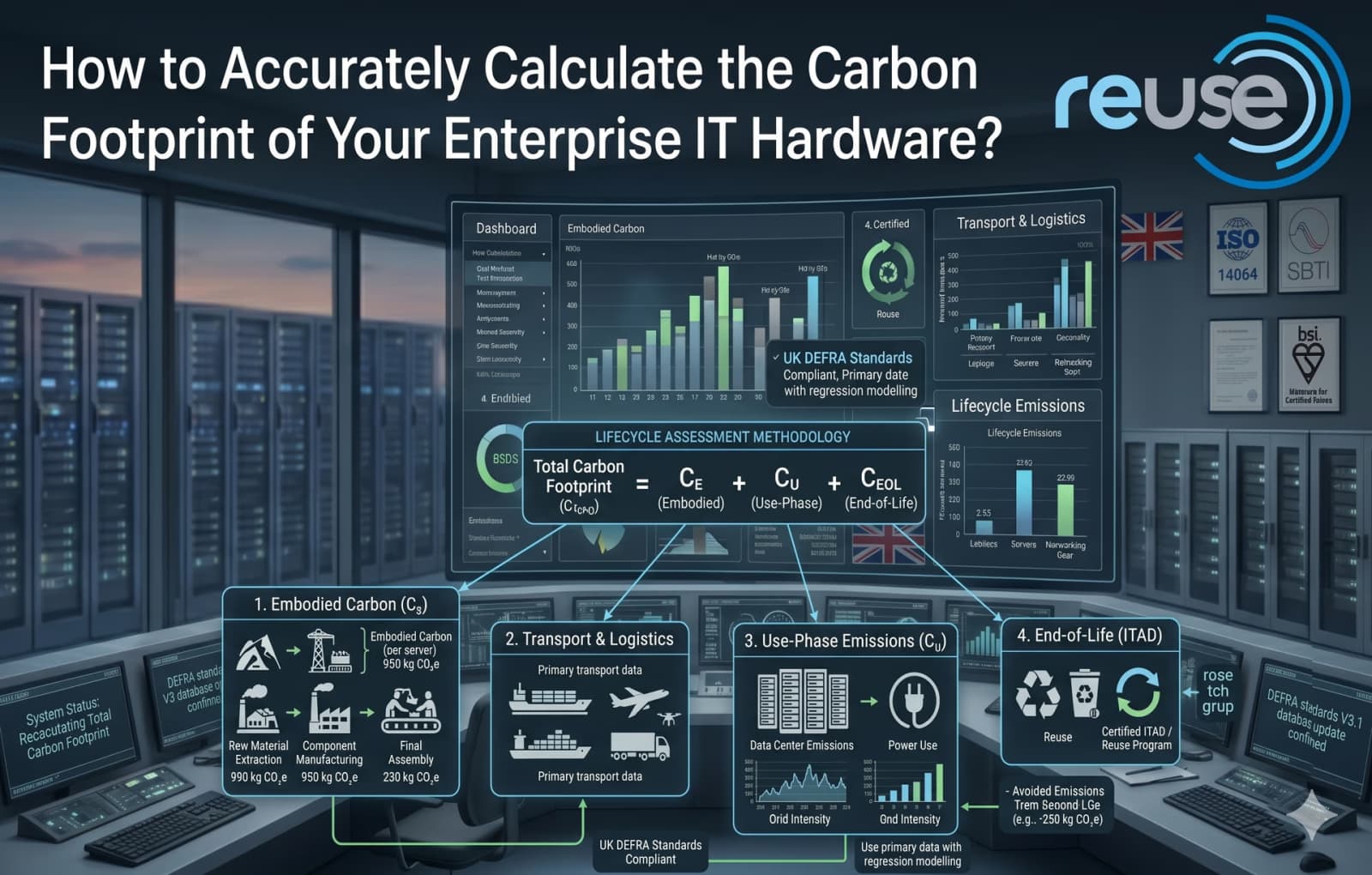
- Applying Lifecycle Assessment (LCA): Move beyond simple spend-based estimations. Analyse the emissions across the four primary stages of the equipment's life: Manufacturing, Transport, Use, and Disposal.
- Data Categorisation: Utilise primary data whenever possible. Request Product Carbon Footprint (PCF) reports directly from your manufacturers (such as Dell, Lenovo, or HP), which provide detailed, product-specific emission estimates based on the Product Attribute to Impact Algorithm (PAIA).11
- Emissions Factor Application: For operational electricity consumption and secondary data gaps, multiply your usage and asset data by the relevant carbon intensity factors. You must use the official, annually updated UK government conversion factors provided by the Department for Energy Security and Net Zero (DESNZ) and DEFRA.
Understanding the Lifecycle Assessment (LCA) Model
To master carbon accounting, you must understand the nuances of the four-stage lifecycle assessment model.
Manufacturing & Embodied Carbon
The highest proportion of emissions for end-user IT hardware stems from the manufacturing phase.The extraction of rare earth minerals, the refinement of petrochemical plastics, and the highly energy-intensive cleanroom environments required to fabricate silicon wafers, lithium-ion batteries, and LCDs create an enormous embodied carbon debt long before the device is turned on.
Distribution & Logistics
This stage accounts for the carbon cost of shipping hardware from overseas manufacturing hubs to UK offices. It encompasses complex logistics, including air freight, container shipping, and last-mile road transport. The GHG Protocol advises using specific allocation techniques, such as the shortest theoretical distance (Great Circle Distance), to accurately assign transport emissions to specific IT shipments.
The Operational Phase
This phase covers the energy consumption during the years of active use. While laptops draw minimal power, the operational phase is the dominant emissions factor for enterprise servers and data storage arrays. Because servers run continuously under high computational loads, their operational electricity draw often accounts for nearly 80% of their total lifecycle footprint.
End-of-Life & Circular Economy
How a device is retired heavily impacts its final footprint. Routing equipment to landfill generates entirely negative environmental consequences. However, secure recycling and reuse within the circular economy can effectively "offset" or reduce the total footprint.By recovering secondary materials from electronic waste, businesses substitute the need to extract virgin materials. Studies of the UK's WEEE system demonstrate that the avoided emissions from recycling drastically outweigh the processing emissions, resulting in a net carbon footprint benefit.
Tools and Resources: Choosing a Carbon Calculator
Calculating these precise figures manually using spreadsheets is highly prone to error and makes auditing incredibly difficult. Thankfully, a variety of carbon calculators and specialised software platforms exist to automate these complex calculations.
For Small and Medium Enterprises (SMEs) in the UK, the government-backed SME Climate Hub offers both a Small Business Carbon Calculator and an Advanced Business Carbon Calculator. These free, auditable tools are designed to help smaller organisations measure their Scope 1, 2, and 3 emissions accurately.
Larger enterprises should consider integrating enterprise-grade IT Asset Management (ITAM) platforms that feature dedicated carbon tracking capabilities. These platforms automatically pull hardware telemetry, align it with manufacturer PCF databases, and cross-reference the data with the latest DESNZ conversion factors to ensure total SECR compliance.
Achieving true supply chain transparency and meeting stringent UK frameworks like SECR, NIST cybersecurity standards for data sanitisation, and WEEE compliance requires expert support. By partnering with enterprise ITAD leaders such as Reuse Technology Group, you can confidently calculate the carbon footprint of IT hardware and guarantee secure, sustainable asset disposition while feeding accurate data back into your reporting tools.
How to Reduce Your IT Carbon Footprint Post-Calculation
Gathering the data is only the beginning. Once you understand your emissions baseline, you must take strategic action to decarbonise your estate.
- Extend Device Lifecycles: The most mathematically sound way to lower your footprint is to use your existing devices for longer. Adding just two additional years of active use to an average PC amortises its massive manufacturing footprint, reducing the device's annualised carbon footprint by up to 30%.
- Prioritise Remanufactured Hardware: Shifting your procurement strategy away from brand-new devices yields exponential environmental dividends. A peer-reviewed study by Cranfield University found that a remanufactured laptop produces only 6.34% of the CO2e emissions compared to a newly manufactured equivalent.
- Ensure WEEE Compliant Disposal: Always dispose of legacy hardware through certified IT Asset Disposition (ITAD) channels that guarantee zero-to-landfill policies and prioritise component harvesting and reuse.
Calculation is only the first step. To execute a seamless, low-carbon hardware strategy
Conclusion:
To effectively calculate the carbon footprint of IT hardware, modern enterprises must adopt a rigorous, data-driven methodology that looks far beyond the electricity plug at the wall. By understanding the profound impact of embodied carbon, implementing precise lifecycle assessments, and embracing the circular economy, UK businesses can confidently shrink their environmental impact and accelerate their journey toward a sustainable, net-zero future.
Frequently Asked Questions
What is the difference between embodied and operational carbon?
Embodied carbon refers to the greenhouse gases emitted during the upstream supply chain processes—this includes raw material extraction, component manufacturing, assembly, and global transportation. Operational carbon is generated purely by the electricity the hardware consumes while it is plugged in and actively being used by your organisation.
Can a carbon calculator be 100% accurate?
Due to the profound complexity, opacity, and rapid fluctuations of global electronics supply chains, achieving 100% exact, down-to-the-gram accuracy is currently impossible. However, modern carbon calculators utilise highly advanced, process-based Lifecycle Assessments and streamlined algorithms like PAIA. These tools provide a scientifically robust, statistically sound estimation that is fully accepted by international auditing bodies and the GHG Protocol for corporate reporting.
How do I report Scope 3 emissions of IT equipment in the UK?
While the standard UK SECR regulations mandate the reporting of Scopes 1 and 2, reporting on Scope 3 is heavily encouraged as a best practice. Furthermore, if your organisation is bidding on UK central government contracts valued at £5 million or more, Procurement Policy Note 06/21 (PPN 06/21) legally requires you to publish a board-approved Carbon Reduction Plan (CRP) that explicitly details a defined subset of your Scope 3 value chain emissions.
Struggling with Scope 3 IT emissions and UK compliance mandates? Partner with Reuse Technology Group for accurate, stress-free carbon accounting.
Fill out the contact form below to transform your IT infrastructure into a driver for net-zero.